
Light Requirements
How much water do sunflowers need by growth stage?
Sunflowers thrive on consistency, but their water needs shift dramatically as they grow—from delicate sprouts to towering giants reaching for the sky. Understanding these stages helps you avoid common pitfalls like root rot from overwatering or wilting stalks from drought stress.
Let’s break down the science-backed moisture targets for each phase, so your sunflowers grow strong and healthy.
During germination (weeks 1-2), seeds need barely any water—just enough to keep the soil lightly moist (about ¼ inch per week). Overwatering here can cause seeds to rot before they sprout.
Once sprouts emerge, increase to ½ inch per week while ensuring the soil stays evenly damp but not soggy. This is when their taproots begin forming, and consistent moisture is critical.
| Growth Stage | Water Needs | Frequency | Key Tips |
|---|---|---|---|
| Germination (Weeks 1-2) | ¼ inch/week | Every 2-3 days (light mist) | Keep soil evenly moist, avoid puddles |
| Seedling (Weeks 3-4) | ½ inch/week | Every 3-4 days | Support taproot development with deep watering |
| Vegetative (Weeks 5-8) | 1-1.5 inches/week | Every 2-3 days | Water deeply to encourage stem strength |
| Flowering (Weeks 9-12) | 1.5-2 inches/week | Every 1-2 days | Critical for bud formation and pollen production |
| Seed Production (Weeks 13+) | 1 inch/week | Every 3-5 days | Reduce water to harden seeds for harvest |
The vegetative stage (weeks 5-8) is when sunflowers grow fastest, and their water needs spike to 1-1.5 inches per week. This is where deep watering—soaking the soil 6-8 inches deep—prevents shallow roots and ensures sturdy stalks.
I’ve found that watering in the early morning minimizes evaporation and fungal risks, like powdery mildew, which thrives in damp foliage.
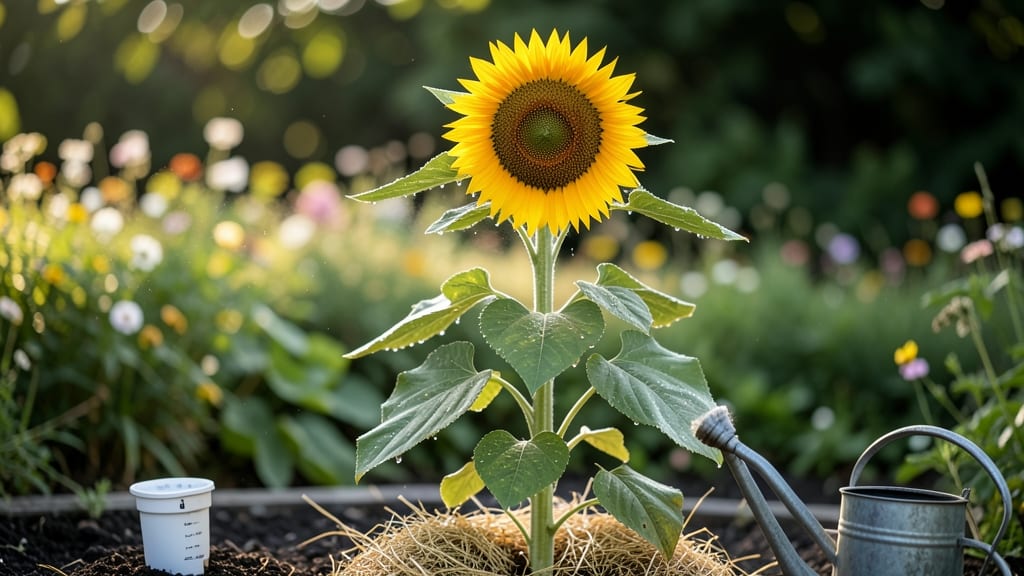
When buds form (weeks 9-12), your sunflowers demand the most water: 1.5-2 inches weekly. This supports pollen development and prevents buds from dropping before opening. A trick I use is to mulch around the base with straw to retain moisture and suppress weeds, which compete for water.
Avoid wetting the leaves—always direct water to the soil to keep foliage dry.
During seed production (weeks 13+), reduce water to about 1 inch per week. This helps the seeds mature properly and prevents cracking. If you’re growing sunflowers for cut flowers, maintain slightly higher moisture until harvest.
For seed production, let the soil dry out a bit between waterings to improve shell hardness.
Climate plays a huge role—sunflowers in hot, dry regions (like Arizona or California) may need daily watering during peak summer, while those in cooler climates (like the Pacific Northwest) can go 4-5 days between waterings.
Always check soil moisture by sticking your finger 2 inches deep: if it’s dry, water; if damp, wait. Overwatering here is just as harmful as underwatering.
One of my biggest lessons? Container-grown sunflowers dry out faster than in-ground plants. If you’re growing them in pots, water every 2-3 days in summer, as their roots can’t access deep moisture.
Use well-draining soil mixed with perlite to prevent root rot. For in-ground plants, focus on deep, infrequent watering to encourage those powerful taproots.
Pro tip: Use a moisture meter or the "squeeze test"—grab a handful of soil near the roots. If it crumbles easily, water; if it stays clumped, wait. This simple trick saves time and keeps your sunflowers thriving.
With the right watering strategy, you’ll watch those stalks soar from seed to sun in just a few months!
🌱
Signs of overwatering vs. underwatering sunflowers (and how to fix it)
Sunflowers might look tough, but their deep taproots and rapid growth make them surprisingly sensitive to watering mistakes. Too little water causes wilting, while too much leads to root rot and stunted blooms.
I’ve seen both scenarios ruin what could’ve been stunning 8-foot giants—so let’s decode the warning signs before they become permanent problems.
First, let’s tackle the obvious signs of underwatering. Your sunflowers will start drooping by midday, even when the soil feels slightly damp. The leaves turn yellowish-green along the edges, and the stalks may feel hollow when squeezed.
If you pull back the foliage, you’ll spot crispy, brown roots instead of healthy white ones.
⚠️ WARNING: Sunflower Water Requirements ⚠️ Sunflowers need 1-2 gallons of water per week during peak growth (May-July), but their needs shift by stage. Germination requires consistent moisture—never let the soil dry out completely.
Once established, they tolerate drought better than soggy soil. Overwatering is riskier: it causes fungal diseases like powdery mildew and root rot, which can kill your plants in weeks. Always check soil moisture 2 inches deep before watering—if it’s damp, wait another day.
Now, let’s focus on overwatering symptoms. The first clue is yellowing leaves that stay soft, even when dry. You might also notice white, fuzzy mold on stems or leaves—this is powdery mildew, a classic overwatering red flag.
The soil around your sunflowers will smell sour or musty, and the roots may appear mushy and dark brown when exposed. Worse yet, your plants might lean or fall over despite having strong stems.
Fixing underwatered sunflowers is simpler: give them a deep watering (1-2 gallons) in the morning and mulch heavily to retain moisture. For overwatered plants, the first step is stopping all watering immediately.
If the soil is waterlogged, dig a drainage trench around the base or move potted sunflowers to a well-draining spot. Prune any moldy or mushy leaves with sterilized shears to prevent spread.
Prevention is key! I recommend watering sunflowers early in the morning to let foliage dry before nightfall—this cuts fungal risks by 60%.
Use a moisture meter to check soil levels, and avoid watering at night, even if your schedule demands it. Drip irrigation is ideal because it delivers water directly to roots without wetting leaves, reducing disease risk.
Remember, sunflowers are resilient, but they’re not drought-proof or flood-tolerant. Pay attention to the soil texture and leaf color, and adjust your watering routine every 2-3 weeks based on weather.
With the right balance, you’ll grow sunflowers that reach their full height and bloom like golden beacons all summer. 🌻