
Light Requirements
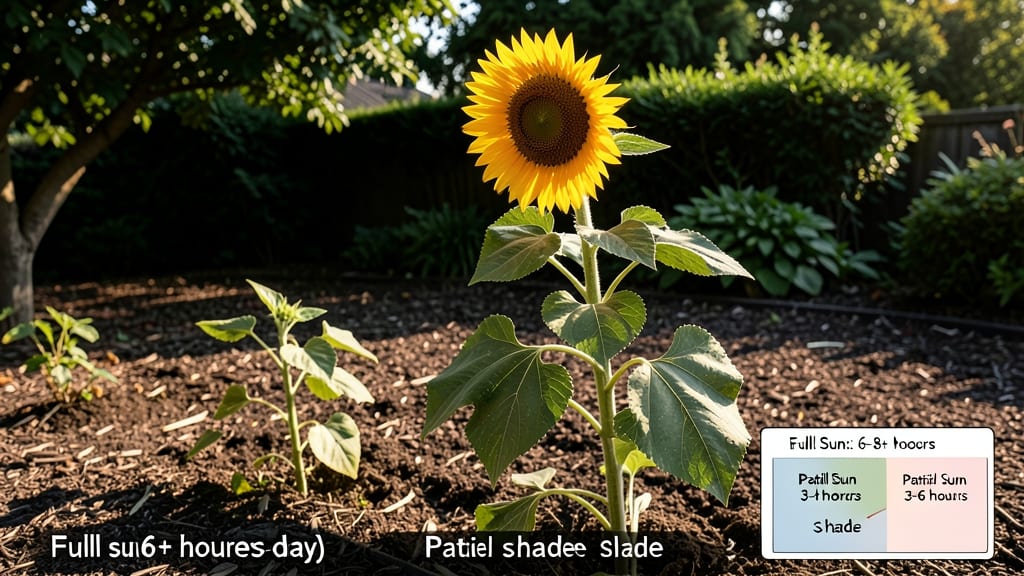
To grow sunflowers that reach their towering, show-stopping potential, you’ll need to know how much light a sunflower needs—because these cheerful giants are obsessed with light, and cutting corners here means smaller blooms, leggy stems, or flowers that never even open.
Let’s break down exactly how much sunlight your 🌻 needs to thrive, plus how to troubleshoot if they’re not getting enough.
Most sunflowers demand at least 6-8 hours of direct sunlight daily, though 8+ hours is ideal for those 10-foot-tall giants you’ve been dreaming of.
Think of it like their daily vitamin: skip the dose, and they’ll stretch toward the sky like they’re reaching for a better spot—weak, pale, and prone to flopping over.
Even partial shade can stunt their growth, so if your garden’s in a shadier spot, we’ll share clever workarounds to keep them happy.
But here’s the thing: sunflowers aren’t just picky—they’re communicative. Struggling plants will tell you exactly what’s wrong through their leaves, stems, and blooms.
We’ll walk you through the telltale signs of light deprivation (spoiler: leggy stems are a red flag) and how to fix it, whether you’re dealing with a container on a balcony or a shaded backyard corner. Ready to give your sunflowers the light they crave?
By the end of this guide, you’ll know not just how much light sunflowers need, but how to maximize it in any space—because even the sunniest garden can use a little extra brightness. Let’s get those stalks standing tall and proud!
 Best Window Placement
Optimal sunlight requirements for sunflowers: hours and intensity explained
Sunflowers thrive under full sun, but their exact needs vary by variety—whether you're growing giant, dwarf, or standard types. The key is understanding how sunlight fuels their growth through photosynthesis, converting energy into those iconic blooms.
Without enough light, sunflowers become weak, leggy, and may fail to flower entirely. Let’s break down the science and specifics so you can give your sunflowers the perfect light prescription.
Sunflowers are heliotropic, meaning they follow the sun’s movement throughout the day. This behavior maximizes their energy absorption, but it also means they need consistent, direct sunlight.
The minimum requirement is 6 hours of full sun daily, but most varieties perform best with 8-10 hours of direct sunlight. Even partial shade can stunt their growth, especially for giant varieties, which demand the most light to reach their towering heights.
Sunlight intensity matters just as much as duration. Sunflowers need bright, direct sunlight, not diffused or filtered light. Morning sun is ideal for photosynthesis, while afternoon sun helps dry foliage quickly, reducing fungal diseases. If your garden receives intense afternoon heat, providing some afternoon shade can prevent leaf scorch without sacrificing growth.
Sunflower varieties have distinct light needs, so choosing the right type for your space is crucial. Giant sunflowers, like 'Mammoth' or 'Russian Giant,' require the most light—10+ hours daily—to reach their impressive heights of 10-16 feet. Standard varieties, such as 'Autumn Beauty,' thrive with 8-10 hours of sun and grow 6-8 feet tall. Dwarf sunflowers, like 'Teddy Bear' or 'Sunspot,' are the most adaptable, tolerating 6-8 hours of sun and reaching only 2-4 feet in height.
| Variety | Minimum Sunlight | Ideal Sunlight | Height Range | Partial Shade Tolerance |
|---|---|---|---|---|
| Giant (e.g., 'Mammoth') | 10+ hours | 10-12 hours | 10-16 ft | Poor; stunted growth |
| Standard (e.g., 'Autumn Beauty') | 8 hours | 8-10 hours | 6-8 ft | Moderate; smaller blooms |
| Dwarf (e.g., 'Teddy Bear') | 6 hours | 6-8 hours | 2-4 ft | Good; minimal impact |
The science behind sunflower energy demands lies in their chlorophyll and leaf structure. Sunflowers have large, broad leaves designed to capture maximum sunlight. When light hits these leaves, chloroplasts convert it into chemical energy through photosynthesis, fueling growth and flower production.
Without sufficient light, this process slows, leading to weak stems, smaller blooms, and even premature bolting (when the plant flowers too early).
If your sunflowers are planted in a partial shade area, expect reduced vigor and fewer blooms.
For example, a standard sunflower in 4-6 hours of sun may grow 20-30% shorter and produce half as many flowers compared to one in full sun. Dwarf varieties handle partial shade better but still benefit from at least 6 hours of direct light to prevent leggy growth and poor flowering.
For gardeners in shaded or urban spaces, maximizing sunlight exposure is key. Plant sunflowers in the sunniest spot
Signs your sunflowers aren’t getting enough light (and how to fix it)
If your sunflowers look more like tall, lanky weeds than the bold, golden giants you planted, your first suspect should be light deprivation. Sunflowers are sun-worshippers, and when they don’t get enough, they’ll stretch, wilt, or even refuse to bloom.
The good news? These plants are eager to tell you what’s wrong—you just need to know what to look for.
Start by checking their leaves. Healthy sunflower leaves should be deep green and sturdy, but if they’re pale, yellowing, or sparse, your plants are begging for more light. You might also spot leggy stems that bend or flop over, a classic sign they’re reaching for sunlight.
Even the flower buds will give you clues: if they’re small, sparse, or never fully open, light starvation is likely the culprit.
⚠️ callout warning
Sunflowers need 6-8+ hours of full sun daily—that’s direct, unfiltered sunlight, not dappled shade. Partial shade (less than 4 hours of sun) will stunt growth, weaken stems, and reduce blooms. If your garden gets less than 6 hours, your sunflowers will struggle to thrive, no matter how much you water or fertilize.
💡 Pro Tip: Use a sunlight tracker (or your phone’s compass) to measure daily light exposure. If your spot gets less than 6 hours, it’s time to relocate or supplement with grow lights.
For outdoor gardeners, the fix often starts with location adjustments. If your sunflowers are planted under trees or near tall structures, transplant them to a sunnier spot as soon as possible. Even a 3-foot shift toward the south can make a dramatic difference.
If your yard is uniformly shady, consider reflective surfaces like white gravel, mirrors, or even light-colored mulch to bounce extra light onto your plants.
Indoor growers face a bigger challenge, but grow lights can save the day. A full-spectrum LED grow light placed 6-12 inches above your sunflowers for 12-14 hours daily mimics sunlight and prevents legginess.
Just avoid cheap incandescent bulbs—they generate too much heat and can scorch delicate leaves. Instead, opt for cool-white or red/blue spectrum LEDs, which are energy-efficient and gentle on plants.
Don’t overlook the power of companion planting to boost light exposure. Tall, reflective plants like corn, borage, or even silver foliage plants can help redirect sunlight onto your sunflowers. Another trick? Thin out nearby plants to reduce competition for light.
If your sunflowers are crowded, their leggy stems will only get worse as they stretch for any available sunshine.
Finally, if your sunflowers are already bolting prematurely (sending up flower stalks too early), they might be compensating for low light by rushing to reproduce. In this case, prune the flower buds to encourage stronger stem growth, then move the plant to a sunnier location.
With the right light conditions, your sunflowers will rebound quickly, producing bold, healthy blooms that’ll turn heads all summer long. 🌻